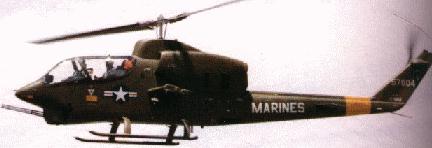
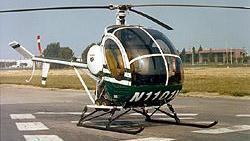
The Bell AH-1 is an example of a semi-rigid rotor system.
A helicopter "rotor system" is the unit that is composed of
a hub and the blades attached to it. Each rotor is considered a separate
system, and a helicopter may have more than one main rotor.
There are three primary types of rotor systems: articulated, semi-rigid,
and rigid.
The articulated rotor system first appeared on the autogyros of the 1920s
and is the oldest and most widely used type of rotor system. The rotor blades
in this type of system can move in three ways as it turns around the rotor
hub and each blade can move independently of the others. They can move up
and down (flapping), back and forth in the horizontal plane, and can change
in the pitch angle (the tilt of the blade).
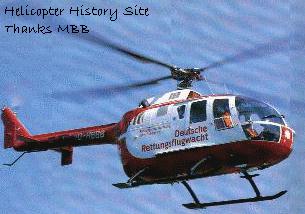
The Messerschmitt-B”lkow-Blohm BO-105 (Germany) is an example of a rigid-rotor
helicopter.
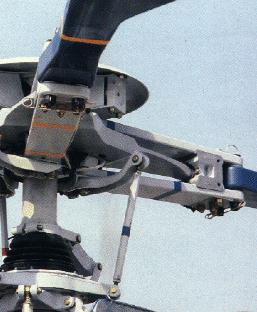
The rotor assembly on a fully articulated rotor system.
In the semi-rigid rotor system, the blades are attached rigidly to the
hub but the hub itself can tilt in any direction about the top of the mast.
This system generally appears on helicopters with two rotor blades. These
systems resemble a seesaw—when one blade is pushed down, the opposite
one rises.
The rigid rotor system resembles an ordinary propeller and is the least
often used. The blades are fixed to the hub without hinges and the hub is
fixed to the shaft. The blades on rigid rotor systems flex. This configuration
is most like the airscrew envisioned by Leonardo da Vinci and George Cayley.
The rotor hub on a fully articulated rotor system.
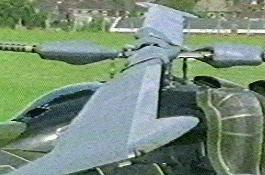
The Hughes TH-55A Osage has a fully articulated rotor system.


 Home | About Us | Wright Brothers History | History of Flight | Sights & Sounds | Education | Sitemap