

| |
| |
| | 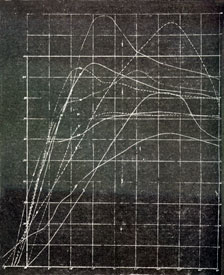 Wright wind tunnel graph of airfoil tests, 1901 | | Where was the error? The reason for the wind tunnel was easy: while designing their gliders, the Wrights had carefully followed the accepted formula for determining lift, using constant values determined by Lilienthal and Smeaton. The gliders did not fly as well as the formula had predicted. Something was wrong. The Wrights suspected two parts of the lift formula. The formula stated the following: L = CL x K x S x V2 Lift (weight to be lifted) = Lift coefficient (from Lilienthal) x coefficient for air pressure (Smeaton's) x Surface area x velocity (squared). In 1900 and 1901, the Wrights designed their gliders by plugging in the information they knew into the formula, estimating the weight and speed of the machine and including Lilienthal's lift coefficient and Smeaton's pressure coefficient. When the gliders flew so poorly, the Wrights quickly surmised that the error must lie in that data supplied by others - Lilienthal and Smeaton. The Wrights' wind tunnel experiments were started to determine the accuracy of Otto Lilienthal's lift coefficients. Using the flight test data from the 1901 gliding season, Wilbur developed his own value for Smeaton's coefficient. In each case, the Wrights' numbers differed from Lilienthal and Smeaton. They chose to trust their own. | |
| |