

| |
| |
| | 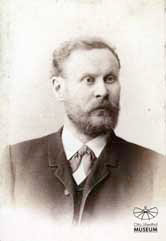 Otto Lilienthal | | Lilienthal's Experiments Otto Lilienthal (1848-1896) was a highly trained civil engineer. He ran a small factory, and, with his brother Gustav, pursued the study of flight which had been an interest since his boyhood. Although best known for his gliders and pioneering flights, Lilienthal was perhaps most important to the Wrights for his theoretical approach to flight and the scientific data he developed and compiled. Lilienthal approached flight as an engineer. His work was based on the notion of birdflight as an acceptable model for human flight (Jakab, p.33). He had spent hours studying the storks in flight near his home, and, beginning in 1867, performed experiments to determine the characteristics of efficient wings. Lilienthal's controlled experiments included whirling arm tests, measuring the amount of lift generated by a wing against a flat plate of known resistance. As the wing lifted, he measured the amount of deflection in a tension spring and calculated the lift coefficients over a series of angles of attack. the results of these tests were compiled into tables of lift data for wings - the first such tables ever produced. With his first public lecture in 1873, Lilienthal's theories and tests became widely available throughout the world, published in a variety of books and journals. The Wrights' faith in Lilienthal's work was absolute as they started their work. Almost every aspect of their scientific approach to flight can find a precedent in Lilienthal's work: theories based on observation, design based on reliable data, experiments carried out in controlled environments and recorded in detail. When they began to question his experimental data following the disappointing flights of 1901, they began their wind tunnel experiments to confirm his work, not disprove it. At the conclusion of their experiments, Wilbur even wrote, "I am led to think that Lilienthal himself had noticed that there was a discrepancy between his glides and his tables, at small angles especially."(McFarland, p.173) | |
| |