

|
|
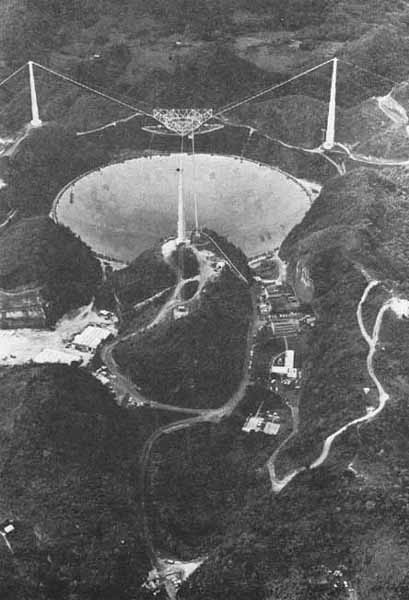
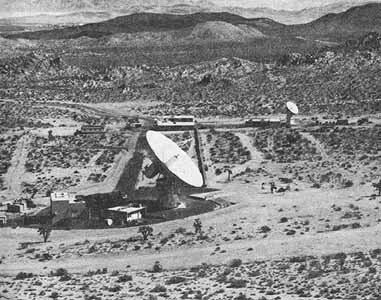 View of Arecibo Observatory
in Puerto Rico with its 300-meter dish antenna, the world’s
largest. A small fraction of its observation time has been devoted
to searches for extraterrestrial life.
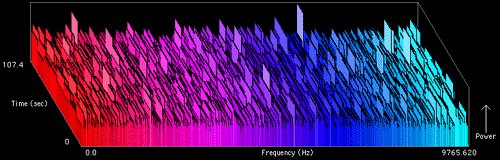 This picture is generated
by free software that SETI provides to people who are interested
in looking for signals from intelligent extraterrestrials.
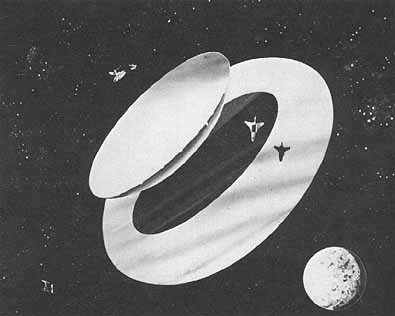 Artist’s concept
of an intermediate size (300-meter) space SETI system antenna showing
two feeds, a relay satellite, radio frequence interference (RFI)
shield and a Shuttle-type vehicle. Such a system would be located
in geosysnchronous orbit or beyond.
 This is a page from
a "UFO Fact Sheet" released in 1977 in response to a Freedom of
Information inquiry on Project Blue Book an Air Force project relating
to UFOs terminated in 1969.
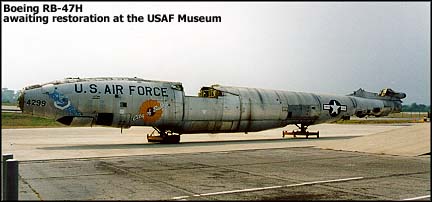 In July 1957, the
pilot of an RB-47 reconnaissance plane like the one pictured here
saw an unexplained streak of light and received mysterious transmissions.
Fifteen years later, the signals were determined to have come from
Air Force radar and the streak of light from a meteor.
 Two parabolic reflector
antennas, forming the research and development site of NASA’s worldwide
Deep Space Network, stand out against the Southern California’s
Mojave Desert. Antennas such as these can be used for sky and frequency
SETI surveys. Depending on frequency, such antennas can perform
all-sky surveys over plausible microwave regions with several orders
of magnitude better sensitivity than has been generally achieved.
|
UFOs and Extraterrestrials
In June l947, a pilot named Kenneth Arnold declared that he had seen mysterious disk-shaped objects in the sky while flying near Mount Rainier in Washington state. Newspapers picked up his story; reporters began writing of "flying saucers" that might have come from outer space. Other people soon told of similar sightings. The Air Force responded by setting up an office to collect such reports, launching an effort that came to be called Project Blue Book, which ran until 1969. Avoiding the term "flying saucer," project officials wrote instead of "unidentified flying objects," or UFOs. Project Blue Book, operating out of an office at Wright-Patterson Air Force Base in Ohio, had as its purpose to learn whether these UFOs might threaten national security. The work of Project Blue Book gained urgency as an event in January l948 suggested that these UFOs could pose a military threat. Shortly after noon on that January day, a number of people began phoning police stations, asserting that they had seen a UFO flying at high altitude. Police officers passed these statements on to a nearby U.S. Air Force base, where operators in the control tower soon saw the UFO themselves. A flight of fighter planes approached the base, and a man in the tower radioed their leader, Captain Thomas Mantell, asking him to investigate. He replied, "I have an object in sight...it is of tremendous size...I am trying to get close for a better look." Then his radio transmissions ceased. The plane plunged from the sky, out of control, and killed him. Had the UFO shot down Mantell’s fighter? The Air Force’s investigation reached quite a different conclusion. The UFO proved to have been a Skyhook balloon, which was very large and could reach altitudes above 70,000 feet (21,336 meters). It had prompted the reports from the telephone callers. Mantell had no oxygen supply, and when he flew above 20,000 feet (6,096 meters), he lost consciousness. His plane then went into its fatal dive. Subsequent years brought other reports. Early in l95l, two fighters were in the air over Tennessee, conducting an exercise using their onboard radars. One pilot saw a UFO on his scope, ten miles (16 kilometers) away and at a higher altitude. He chased it, and as he closed to approach it, it descended until it was below him. He looked out from his cockpit, trying to see it, and saw that the blip had led him to a highly secret plant that was processing uranium for use in nuclear weapons! Had the UFO been spying, perhaps even approaching that facility with hostile intent? In fact, right from the start the blip had been produced by the plant itself, which had broad walls that showed up well on radar. Conditions in the atmosphere had caused the radar beam to bend downward, reaching the ground from ten miles (16 kilometers) away. This beam had initially been directed upward, which is why the pilot’s radar scope showed the UFO as being high in the sky. In July l957, an RB-47 reconnaissance aircraft had a particularly dramatic encounter. This airplane was fitted with military electronics, and its crew of six included three specialists in electronics. The encounter began when one of them, Frank McClure, detected a radar signal. It appeared to be coming from a mysterious airplane that was accompanying the RB-47, while traveling somewhat faster. Minutes later, the pilot saw what he later described as "a very intense white light with a light blue tint" that streaked across the plane’s flight path and then disappeared. Was this a UFO? McClure searched for possible radio transmissions from it and picked up a radar signal. Again it seemed to come from a craft that was accompanying the RB-47 while overtaking it. Shortly afterward, the pilot saw a bright light in the sky. He chased it and talked by radio to an Air Force ground station, where radar operators "immediately confirmed the presence of the object on their scopes." Meanwhile, McClure continued to receive transmissions. Then, simultaneously, the UFO vanished from view and disappeared from the ground radar, and the signals McClure had been receiving suddenly ceased. This report was so convincing that it took nearly 15 years to learn what happened, when Phil Klass solved the mystery. Klass had free access to Air Force records and personnel, along with extensive knowledge of military electronics. He determined that McClure’s signals proved to have come from Air Force radars at specific sites. A glitch in McClure’s equipment made it appear that they had come from an overtaking aircraft. The "intense white light" most likely was a bright meteor. The subsequent bright light, seen by the pilot and tracked by ground radar, was the landing lights of Flight 966 of American Airlines. It vanished from view when this plane landed. When McClure’s signal disappeared at the same time, it was because the RB-47 had entered a zone close to a radar station, where its beams passed below the American Airlines plane and could not be received. It certainly was unusual for all these events to occur as they did. Still, among thousands of reports in the Blue Book files, there has been only one RB-47 case. Others have been far more understandable. A 1964 "landing" near Socorro, New Mexico, appears to have been the work of the town’s mayor, who hoped for publicity that would attract tourists. A "landing" in Virginia supposedly left scorches on an asphalt road. These proved to have resulted from gasoline that someone spilled on the pavement and set afire, as part of a hoax. He had used matches, which left charred remains that were found at the site. During the lifetime of Project Blue Book, the project office received a total of 12,618 reports of sightings and left 701 as "unidentified." However, it concluded that there indeed was no national-security threat, and with little continuing need for further work, it was terminated. Sometimes there have been incentives to "see" UFOs. The National Enquirer, a tabloid newspaper, ran a contest and offered prizes for the best UFO reports. One farmer won $5000 when his son stated that a UFO had hovered close to the ground, marking the soil with a whitish ring. Chemical analysis showed that the ring had characteristics that were to be expected if a circular trough of galvanized iron had stood there, to provide water for the farm’s livestock. Some UFOs have shown up in photos. They typically have been pie tins or similar objects, suspended by a thin thread from a tree branch. But there is at least one good movie of UFOs, showing two bright spots of light flying in the distance. They were air force fighters, reflecting the sun as they came in for landings. Aircraft indeed have often been reported as UFOs, particularly when showing unusual patterns of lights or when seen amid uncommon weather conditions. High-altitude balloons have led to further reports, especially when still lit by sunlight while the ground far below is in darkness. Other UFOs have been identified as large satellites or spacecraft, bright stars and planets such as Venus, flocks of birds, reflections of searchlights from clouds, lend-shaped clouds, mirages, and the aurora or Northern lights. One UFO proved to be a firefly trapped between two panes of glass in an aircraft window. Near Brown Mountain in North Carolina, strange lights above the crest result from atmospheric effects that bend the light from distant locomotive headlamps. This absence of extraterrestrial visitors becomes particularly striking when one examines the geological record. If space aliens had built starships and set out to colonize the Galaxy, they might have reached Earth at any time during the past four billion or so years of our planet’s existence. Geologists know of layers in rock formations where dinosaur bones are found. Similarly, the aliens might have left a layer that was rich with their own artifacts, including cities, highways, airports, and commercial centers. The Earth has been awaiting such colonization, but it has never taken place. Critics might object that the people of other stars have been good environmentalists, who have avoided colonizing our planet so as not to disturb its natural ecology. But until about four hundred million years ago, life on Earth existed only in the sea. Aliens then might readily have colonized Earth’s land, which was completely lifeless. In addition, very long-lived space civilizations have had a compelling reason to seek new worlds: Their own star eventually expands enormously in size and burns their home planets to cinders. Still, our geologic record shows no such colonizations. Formally established in 1984, the SETI Institute, the Search for Extraterrestrial Intelligence, represents an ongoing activity that seeks to detect radio signals from Beyond. Aliens might use a powerful laser for communication, but its light would be lost in the glare of their sun. Radio is better; stars emit little radio power, enabling an artificial transmission to stand out sharply. The SETI program uses the world’s largest radio telescope, a thousand feet across, and relies on computers to process the radio noise of distant celestial sources in hope of finding intelligent signals. These signals would not take the form of familiar TV or radio programs. Rather, they would be radio transmissions having a very sharp and well-defined wavelength. Most celestial sources cover a broad range of wavelengths. A sharp wavelength would make a signal stand out, while concentrating its power to make it easier to detect. However, no such signals have been seen. Extraterrestrial civilizations indeed may exist. However, they have left no trace in our fossil record. They have not sent UFOs, and they certainly have done nothing so dramatic as to land in a flying saucer on the White House lawn. Nor have they sent detectable radio transmissions. Here on Earth, the rapid pace of technical advance suggests that within as little as a century, we may be able to transmit our own radio signals. Our Galaxy has existed for over ten billion years. With so much time available, any technically capable race probably would be ahead of us not by mere centuries but by many millions of years. Alternately, they might be millions of years behind us. Accordingly, a number of scientists have asked whether we may be alone in the Galaxy, constituting its most advanced form of intelligent life. T.A. Heppenheimer References and Further Reading: Carlson, Peter. "Alien Armada!" Washington Post, July 21, 2002, F-1. Condon, Edward. Final Report of the Scientific Study of Unidentified Flying Objects. New York: Dutton, l969. Hynek, J. Allen. The UFO Experience: A Scientific Inquiry. New York: Ballantine Books, l974. Klass, Philip. The Real Roswell Crashed-Saucer Coverup. Amherst, New York: Prometheus Books, l997. _________. UFO Abductions: A Dangerous Game. Buffalo, N.Y.: Prometheus Books, l989. _________. UFOs Explained. New York: Random House, l974. _________. UFOs Identified. New York: Random House, l968. _________. UFOs: The Public Deceived. Buffalo, N.Y.: Prometheus Books, l983. "Life in the Universe." Special issue, Scientific American, October l994. Morrison, Philip, editor. The Search for Extraterrestrial Intelligence: SETI. Washington, D.C.: National Aeronautics and Space Administration, 1977. Ruppelt, Edward. The Report on Unidentified Flying Objects. Garden City, New York: Doubleday, l956. Sagan, Carl. Communication with Extraterrestrial Intelligence (CETI). Cambridge, Mass.: MIT Press, l973. "Searching for Extraterrestrials." Scientific American, July 2000, 38-47. Shklovsky, I. S. and Sagan, Carl. Intelligent Life in the Universe. New York: Dell Publishing, l966. Tartar, Jill, and Chyba, Christopher. "Is There Life Elsewhere in the Universe?" Scientific American, December l999, ll8-23. Zuckerman, Ben, and Hart, Michael. Extraterrestrials, Where Are They? New York: Cambridge University Press, l995. "SETI: The Search for ExtraTerrestrial Intelligence." "SETI@home. The Search for ExtraTerrestrial Intelligence." SETI Institute.
|
 Home | About Us | Wright Brothers History | History of Flight | Sights & Sounds | Education | Sitemap Home | About Us | Wright Brothers History | History of Flight | Sights & Sounds | Education | Sitemap |